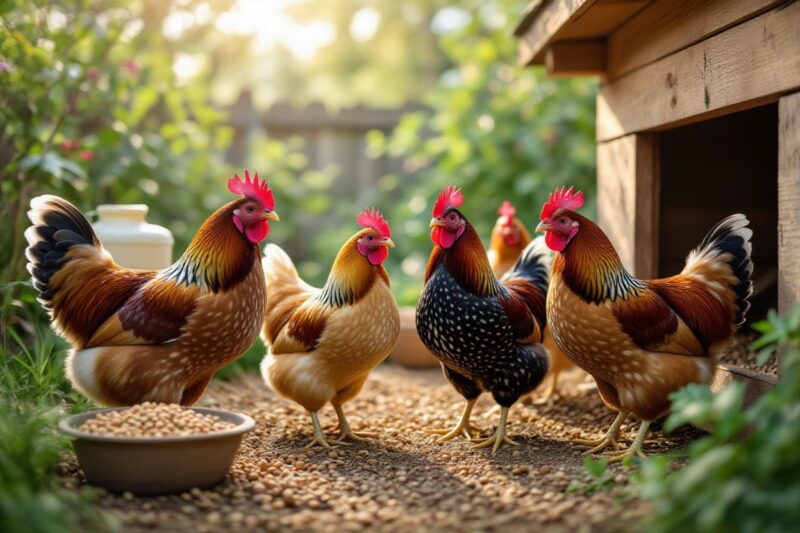
A mature laying hen usually eats about 0.25 pound of complete feed per day. That is roughly 4 ounces or 113 grams. Ten hens will go through about 2.5 pounds a day, 17.5 pounds a week, or one 50-pound bag every 20 days.
Use that number as a planning estimate, not a strict ration. Breed, body size, age, weather, egg production, feed quality, and waste can all change how much disappears from the feeder. The best setup keeps an appropriate complete feed available while giving every bird reliable access to clean water.
Chicken feed calculator
Multiply the number of mature laying hens by 0.25 pound to estimate daily feed:
Number of hens × 0.25 = pounds of feed per day
| Number of hens | Feed per day | Feed per week | Feed per 30 days | Days per 50-pound bag |
|---|---|---|---|---|
| 4 | 1 lb | 7 lb | 30 lb | 50 days |
| 6 | 1.5 lb | 10.5 lb | 45 lb | About 33 days |
| 10 | 2.5 lb | 17.5 lb | 75 lb | 20 days |
| 12 | 3 lb | 21 lb | 90 lb | About 17 days |
| 20 | 5 lb | 35 lb | 150 lb | 10 days |
| 25 | 6.25 lb | 43.75 lb | 187.5 lb | 8 days |
Oklahoma State University Extension uses 0.25 pound per mature hen per day in its backyard-hen budget. Alabama Cooperative Extension gives a broader range of 100 to 150 grams a day, which shows why flock records are more useful than assuming every bird will hit one exact number.
How much chicken feed should you buy?
Start with the flock estimate, then add only enough margin to cover normal variation without leaving feed in storage for months.
For a 10-hen flock:
- 10 hens × 0.25 pound = 2.5 pounds per day
- 2.5 pounds × 30 days = 75 pounds per month
- 75 pounds ÷ 50-pound bags = 1.5 bags per month
If a 50-pound bag costs $22, the estimated monthly feed cost is:
1.5 bags × $22 = $33 per month
Use your real bag price and track how long each bag lasts. That gives you a better budget than a national average, especially when local prices or flock size change.
Why actual feed use changes
Breed and body size
A large dual-purpose hen generally needs more feed than a small commercial-type layer or bantam. The quarter-pound estimate works well for budgeting a mixed backyard flock, but individual birds will vary.
If you are still choosing birds, compare temperament, climate fit, adult size, and expected production in our guide to the best laying chicken breeds. Egg numbers alone do not tell you how efficiently a breed will fit your homestead.
Age and production stage
Chicks, growing pullets, laying hens, and meat birds need different feeds. The package label should state the intended species and life stage. Follow the manufacturer’s directions and your poultry veterinarian or local Extension guidance when a bird has special needs.
Utah State University Extension recommends chick starter for young birds, a grower or developer ration before laying, and a layer diet once egg production begins. It also warns against feeding a high-calcium layer ration to chickens that are not in egg production.
Temperature and season
Feed intake can rise in cold weather as birds use energy to maintain body temperature. Hot weather often reduces appetite, while water needs increase. Shade, ventilation, and dependable water access matter more than trying to force a fixed amount of feed.
Egg production and molt
Active layers have different nutritional demands than birds that are molting or resting from production. A sudden change in feed intake or laying can also signal stress, spoiled feed, a water problem, parasites, illness, or another management issue. Look at the whole flock instead of treating the feeder level as the only clue.
Choose feed by life stage
| Bird stage | Typical feed type | What to check |
|---|---|---|
| Young chicks | Chick starter | Product label, age range, medicated or non-medicated status |
| Growing pullets | Grower or developer | Age range and transition instructions |
| Laying hens | Complete layer ration | Feed intended for birds actively laying |
| Meat birds | Broiler starter, grower, or finisher | Strain-specific program and processing timeline |
| Mixed-age flock | Flock-specific plan | Ask Extension, the feed manufacturer, or a poultry veterinarian |
A complete ration is designed to supply energy, protein, vitamins, and minerals in the right relationship. Adding large amounts of grain, scratch, or scraps dilutes that balance even if the birds eagerly eat the extras.

How much scratch and kitchen scraps can chickens eat?
Keep treats small. Oklahoma State University Extension recommends that scratch grains and kitchen scraps make up no more than 10 percent of the daily diet.
For one hen eating about 4 ounces a day, 10 percent is only 0.4 ounce. For 10 hens, the flock allowance is about 4 ounces total. That is much less than many keepers expect.
Offer treats after the flock has eaten its complete feed. Remove wet or spoiled leftovers before they attract rodents or foul the run. Do not feed moldy food, and check reliable poultry guidance before offering an unfamiliar plant or kitchen item.
Free ranging does not replace a balanced ration
Foraging can add insects, seeds, and greens, and it gives chickens a chance to scratch and explore. The amount they find changes with acreage, season, soil, vegetation, stocking pressure, and weather.
You may notice less purchased feed disappearing when forage is abundant. Still, Utah State University Extension advises providing the appropriate formulated feed because fully free-ranging birds rarely find a consistent balance of all required nutrients.
Keep the complete ration available and treat any reduction in purchased feed as a measured result, not a guaranteed percentage. Weigh feed use across several weeks before changing your budget.
Water controls how well chickens eat
Chickens reduce feed intake when water is unavailable or unappealing. That can affect growth and egg production. Provide fresh, clean water at all times, with enough drinking space that timid birds are not pushed away.
Utah State University Extension estimates an adult bird may drink about 0.05 to 0.08 gallon per day in cool weather and 0.08 to 0.16 gallon in hot weather. Those are planning figures. Spillage, freezing, heat, bird size, and drinker design change how much water you must supply.
Check waterers at least daily and more often during heat or freezing weather. A backup waterer can prevent a tipped or leaking container from leaving the entire flock dry.
How to tell whether chickens are wasting feed
If your flock empties bags much faster than the calculator predicts, look for waste before assuming the birds need more.
- Feed scattered under the feeder or mixed through bedding
- Birds billing feed out with their beaks
- A feeder set too low or filled to the rim
- Rain, condensation, or wet litter spoiling feed
- Rodent droppings, chew marks, or feed disappearing overnight
- Wild birds entering the coop or run
- Old feed collecting in corners of a large feeder
Set the feeder lip near the birds’ back or upper-breast height and avoid overfilling it. Penn State Extension recommends filling trough feeders only one-third to one-half full to reduce waste. Utah State also recommends protecting feed from moisture, rodents, and wild birds.
A well-designed coop makes feeder placement and pest control easier. See our hoop coop building guide for one movable housing approach, or use the housing section of the complete chicken-raising guide as a broader checklist.
Measure your flock’s real feed use
- Start with a known weight of feed.
- Record the number and type of birds.
- Feed normally for seven days.
- Weigh the feed remaining at the end of the week.
- Subtract the remainder from the starting amount.
- Divide by seven, then divide by the number of birds.
For example, if 10 hens use 18 pounds in seven days:
18 ÷ 7 ÷ 10 = 0.257 pound per hen per day
That is close to the quarter-pound planning estimate. Repeat the measurement in hot weather, cold weather, and during peak lay if you want a more accurate annual budget.
If intake changes sharply, inspect feed freshness, water, weather, pests, flock condition, and egg production. Contact a poultry veterinarian or your local Extension office when reduced appetite comes with lethargy, weight loss, diarrhea, breathing trouble, or other signs of illness.
Daily chicken-feeding checklist
- Provide the correct complete feed for the birds’ life stage.
- Keep clean water available without interruption.
- Use 0.25 pound per mature hen as a starting estimate.
- Keep scratch and scraps under 10 percent of the daily diet.
- Check the feeder area for spills, moisture, rodents, and wild birds.
- Track how long each bag lasts.
- Investigate sudden changes instead of automatically adding more feed.
For planning, one mature laying hen needs about 4 ounces of feed a day. Your own seven-day measurement will tell you whether the flock runs above or below that estimate and whether feed is reaching the chickens or ending up on the floor.