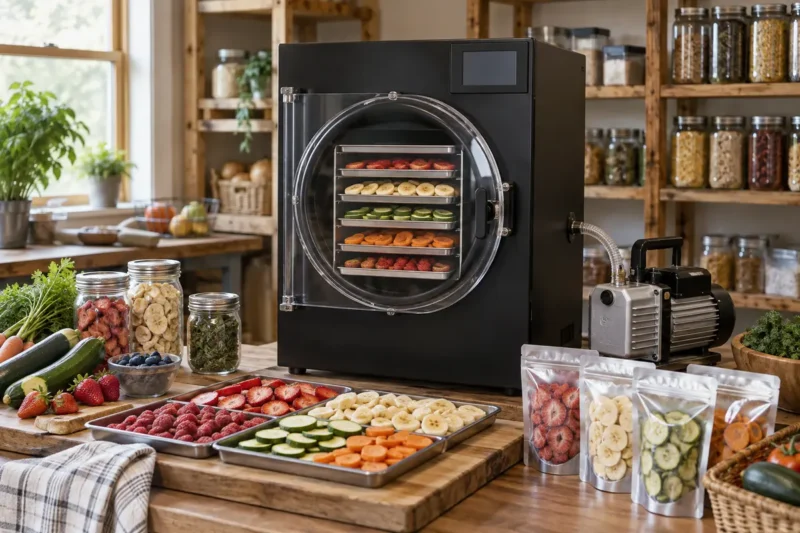
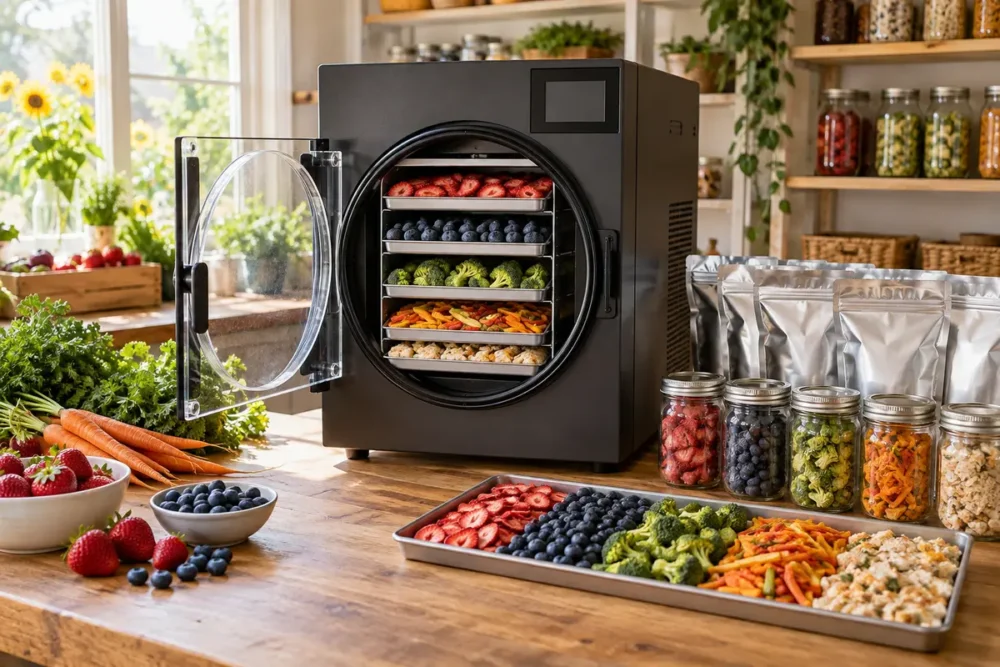
The Harvest Right Home Pro Medium is the best home freeze dryer for most households in 2026. Its 10 to 15-pound batch range, five trays, standard 110-volt connection, established product line, and lower entry price make it the easiest model to recommend for regular home use.
That does not make it the right machine for everyone. Blue Alpine puts more emphasis on faster batches and repairable components. Stay Fresh offers more tray space and a larger stated batch range in its standard model. Harvest Right’s Small is the lower-cost starting point for occasional use.
This guide compares published specifications, electrical needs, capacity, maintenance, and support factors. We have not personally tested every machine listed, so manufacturer performance claims are labeled as such rather than presented as independent test results.
Best home freeze dryers for 2026
| Our pick | Model | Published batch capacity | Electrical requirement | Best for |
|---|---|---|---|---|
| Best overall | Harvest Right Home Pro Medium | 10 to 15 pounds | 110V | Most households and regular garden harvests |
| Best lower-cost entry | Harvest Right Home Pro Small | 6 to 10 pounds | 110V | Occasional batches and limited space |
| Best performance-focused alternative | Blue Alpine Medium | Up to 15 pounds | 120V, 15A breaker | Buyers prioritizing cooling capacity and repairability |
| Best high-capacity standard model | Stay Fresh standard model | 12 to 18 pounds | Dedicated 15A or 20A outlet recommended | Larger batches without moving to a commercial-size unit |
Prices and promotions change often. Confirm the current price, included pump, accessories, shipping terms, and warranty before ordering. Capacity numbers above are manufacturer specifications, not our measured results.
How we chose the best freeze dryer for home use
A useful comparison starts with the machine you can install and run consistently. We weighted the following factors:
- Fresh-food capacity and total tray area
- Electrical circuit requirements
- Machine and pump size
- Oil-pump maintenance and oil-free upgrade options
- Warranty length, parts access, and manufacturer support
- Company history and breadth of the current product line
- Included trays, sealer, bags, absorbers, and starter supplies
We did not award points for universal nutrition percentages, guaranteed shelf life, or claims that a machine will pay for itself. Those outcomes depend on the food, preparation, final moisture, packaging, storage temperature, electricity rates, food cost, and how often the equipment runs.
Best overall: Harvest Right Home Pro Medium
The Home Pro Medium is the most balanced choice for a household that expects to run several batches during harvest season and continue using the machine throughout the year.
Harvest Right lists five trays, 675 square inches of tray space, and capacity for 10 to 15 pounds of fresh food per batch. The cabinet measures 19 inches wide by 25 inches deep by 29 inches high and weighs 119 pounds before you account for moving accessories or the working surface.
The included Premier industrial vacuum pump uses oil. Harvest Right currently says to replace the oil every 20 to 30 batches. An oil-free pump is available as an expensive upgrade, but the lower routine maintenance may not justify its cost for an occasional user.
Choose the Medium when the Small would require too many batches but the Large would sit partly empty. This middle capacity is a better fit for a household preserving garden produce, eggs, cooked meals, or sale-priced ingredients in practical quantities.
- Strengths: useful midrange capacity, established manufacturer, standard-voltage connection, broad accessories and support ecosystem
- Tradeoffs: heavy appliance, external pump, heat and noise during operation, ongoing pump maintenance
Read our Harvest Right freeze dryer review before comparing the current package and pump options.
Best lower-cost entry: Harvest Right Home Pro Small
The Home Pro Small is the logical entry model when price, room, and batch frequency matter more than throughput. Harvest Right lists four trays, 434 square inches of tray space, and capacity for 6 to 10 pounds of fresh food per batch.
The cabinet is 17.4 inches wide by 21.5 inches deep by 26.8 inches high and weighs 91 pounds. It uses a 110-volt outlet and includes the small industrial vacuum pump, trays, impulse sealer, oil filter, starter bags, and oxygen absorbers.
The lower purchase price comes with a real limitation: a large garden harvest can turn into many consecutive batches. Estimate the pounds you expect to process during your busiest month before choosing the smallest model.
Best performance-focused alternative: Blue Alpine Medium
Blue Alpine’s Medium is worth comparing when you care about cooling capacity, standard-size trays, accessible components, and a more repair-focused design.
The company lists five 9-by-13-inch trays, a 20-by-21-by-30-inch cabinet, a 110-pound operating weight with pump, and capacity for up to 15 pounds per cycle. Its published electrical specification is 120 volts on a 15-amp breaker, with a maximum draw of 1,560 watts and an average stated draw of 1,080 watts.
Blue Alpine says a normal 10-pound load can finish in about 24 hours and lists average cycles of 12 to 20 hours. Treat those as manufacturer performance claims. Food type, thickness, starting temperature, room conditions, and final dryness can change batch time.
The 9-by-13-inch trays are a practical detail because replacements are a standard size. The company also promotes parts access and conventional fittings as part of its repairability approach.
- Strengths: standard-size trays, published power figures, configurable controls, repair-oriented components
- Tradeoffs: higher entry price than Harvest Right’s smallest models, shorter market history, manufacturer cycle-time claims need real-world context
Review Blue Alpine’s current Medium specifications and confirm the pump, lead time, and warranty included with the package.
Best high-capacity standard model: Stay Fresh
The standard Stay Fresh model has the largest stated batch range among the three similarly sized machines in this comparison. The company lists five 8-by-20-inch trays, 800 square inches of tray space, and capacity for 12 to 18 pounds of fresh food per batch.
The cabinet measures 20 inches wide by 26 inches deep by 31 inches high and weighs 165 pounds without the 36-pound pump. Stay Fresh recommends a dedicated 15-amp or 20-amp outlet. That weight and footprint make a permanent cart or bench more sensible than moving the machine between batches.
Stay Fresh lists 16 to 30 hours of main drying time for an eight-pound load. As with every published cycle estimate, the finished food still needs to be checked for dryness.
- Strengths: 800 square inches of tray space, 12 to 18-pound stated capacity, replaceable relays and metal construction
- Tradeoffs: considerably heavier than the other standard-size picks, large shipping footprint, dedicated circuit recommended
Check the current Stay Fresh package and specifications before ordering.
What size home freeze dryer should you buy?
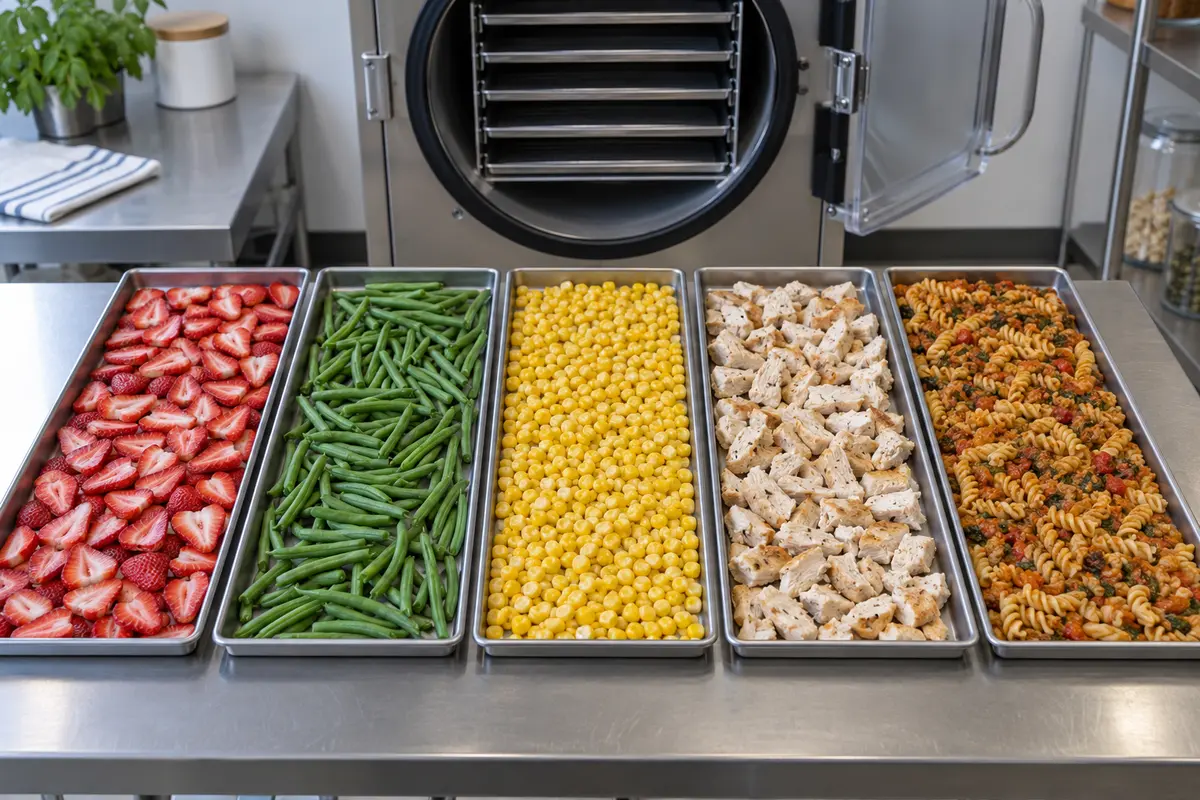
Start with pounds per batch, not household size. Two families of four can use a freeze dryer very differently.
- Weigh the food from one normal preservation session.
- Estimate how many batches you can realistically run each week.
- Compare your peak harvest volume with the manufacturer’s normal and maximum capacity.
- Allow room for the pump, open door, drain hose, cart, supplies, and ventilation.
- Confirm the circuit before buying. Larger machines may need a dedicated 20-amp receptacle.
A machine that is too small creates a backlog. One that is too large costs more, takes more space, and may run partially filled.
Plan the installation before delivery
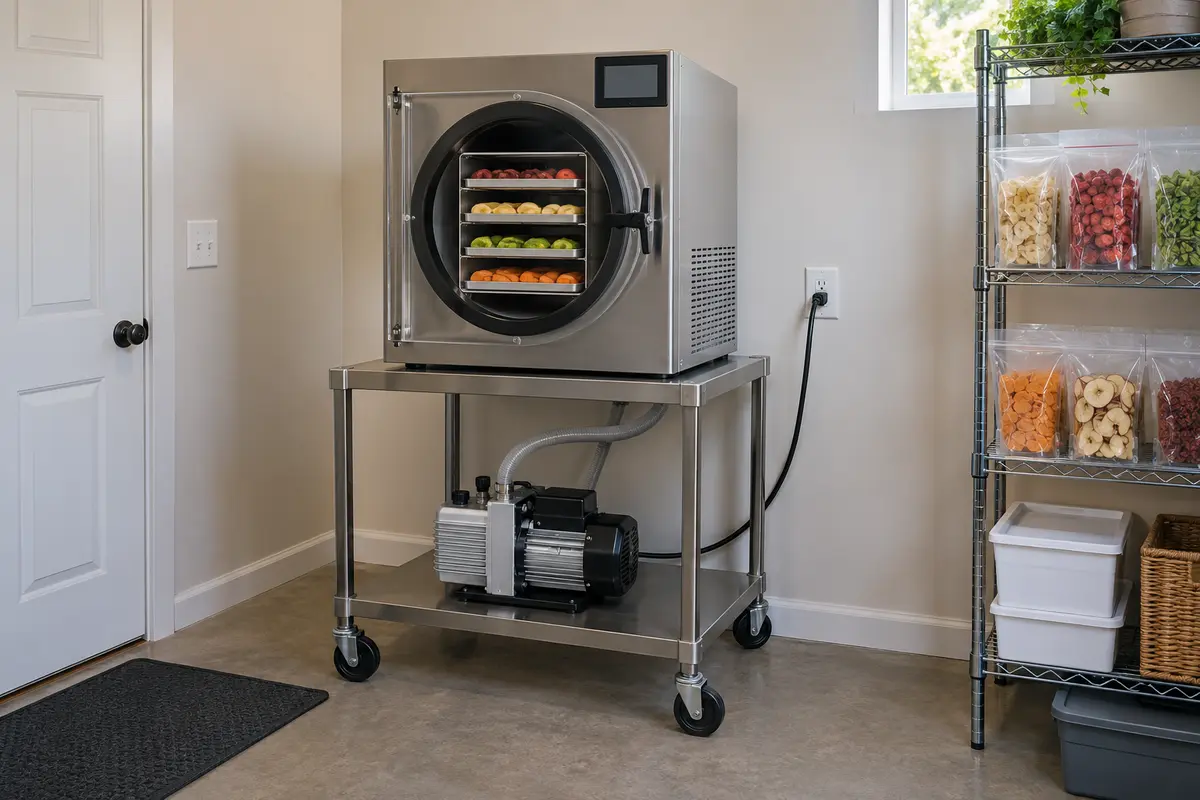
Home freeze dryers are heavy, release heat, and use an external vacuum system. Measure the route from the delivery point to the final location, including doors and stairs. Freight delivery may stop at the curb.
Use a sturdy surface that can support the machine and pump. Follow the manufacturer’s clearance and ventilation instructions, keep the equipment away from water, and avoid an improvised extension-cord setup. A rolling cart can make maintenance easier if the wheels lock and the cart is rated for the full load.
Calculate the real cost per batch
The purchase price is only the first cost. Add electricity, packaging, pump oil or an oil-free pump upgrade, replacement parts, cleaning supplies, and food lost during failed batches.
Electricity cost per batch = average kilowatts × batch hours × your electricity rate
Use a plug-in electricity meter on an appropriately rated circuit to measure several normal batches. Nameplate wattage shows a limit, not necessarily the average draw across an entire cycle.
A payback estimate also needs the actual cost of the fresh food and the price of the comparable freeze-dried food you would otherwise buy. Free garden produce is not truly free once seeds, soil inputs, water, labor, and losses are included.
Freeze-drying safety still depends on preparation and storage
A freeze dryer removes water, but it does not provide a reliable heat-treatment kill step. The University of Minnesota Extension warns that illness-causing microorganisms can survive the process and begin growing again after rehydration.
Handle the food safely before loading, clean and sanitize trays after every batch, test pieces from every tray for remaining moisture, and package the food promptly in a suitable moisture barrier. Label whether the food was raw or cooked and include the processing date.
Extension guidance also notes that independent research on the shelf life of home freeze-dried foods is still limited. The familiar 25-year figure applies to some commercially prepared foods under proper packaging and storage conditions. Do not assume every home batch has the same life.
See the University of Minnesota Extension home freeze-drying guidance for preparation, dryness testing, sanitation, and packaging details.
Which home freeze dryer is worth buying?
Buy the Harvest Right Home Pro Medium if you want the safest all-around choice. It offers enough capacity for regular use without the size and electrical demands of the largest machines.
Choose the Harvest Right Small for occasional batches and the lowest current entry point. Compare Blue Alpine when performance-focused design and parts access matter more than buying from the longest-established home brand. Choose Stay Fresh when 800 square inches of tray space and a 12 to 18-pound stated capacity justify the extra weight.
If the purchase still feels difficult to justify, compare the process and ongoing costs in our freeze dryer versus dehydrator guide. A dehydrator is a much less expensive answer for herbs, fruit leather, jerky, and everyday dried snacks.