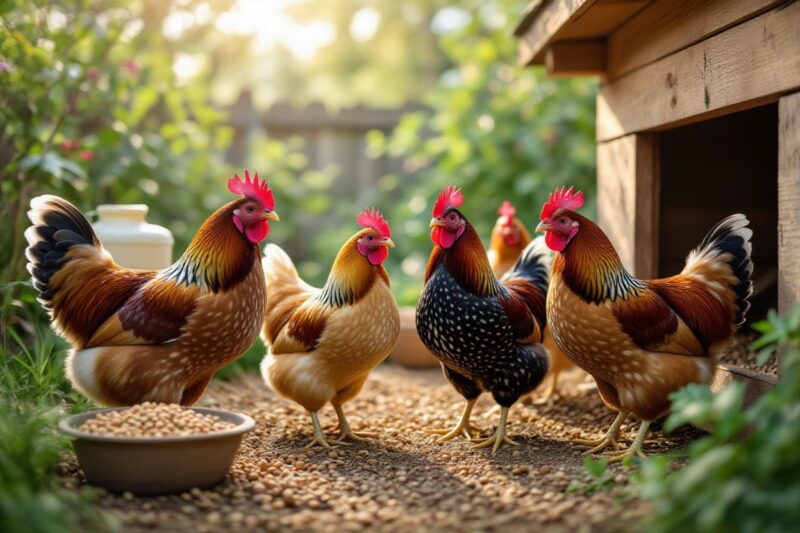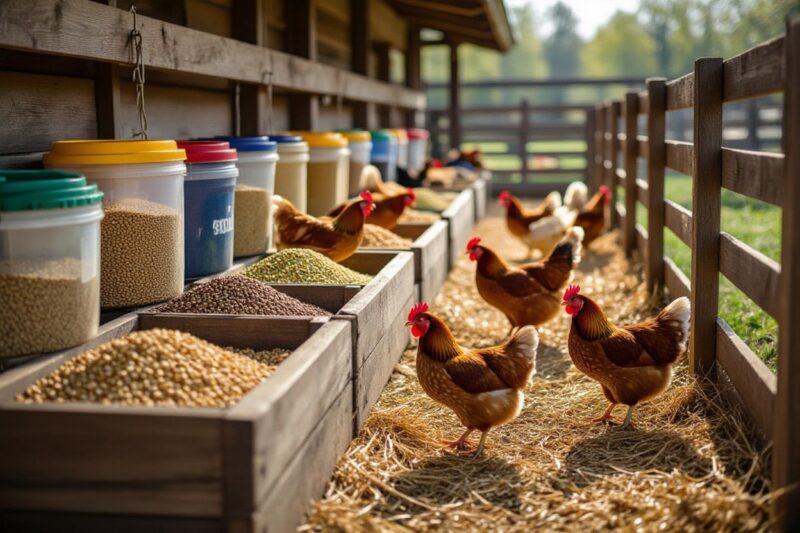
Feed on the ground is not feeding your chickens. It is feeding rodents, wild birds, mold, and the compost pile. If your flock is using bags faster than expected, measure what is being eaten before changing the ration.
A mature laying hen commonly eats about a quarter-pound of complete feed per day. A 10-hen flock should use roughly 2.5 pounds daily, though breed, season, production, and forage change the number. A large gap between that estimate and bag use usually points to spilling, pests, moisture, or poor feeder setup.
Measure feed loss before buying a new feeder
- Weigh the feed offered for seven days.
- Record the number and type of birds.
- Weigh usable feed left at the end of the week.
- Inspect bedding and the ground beneath the feeder.
- Note rodent, wild-bird, and moisture problems.
Use our chicken feed calculator as the baseline. If 10 hens appear to use 25 pounds in a week instead of about 17.5, find where the extra 7.5 pounds went.
Set the feeder at the right height
Raise the feeder so the lip sits near the birds’ back or upper-breast height. A feeder on the ground gives chickens room to scratch bedding into it and rake feed out with their beaks.
Recheck the height as chicks grow. Every bird must still reach feed comfortably, including smaller or lower-ranking flock members.
Stop filling feeders to the rim
Overfilled trays make billing and spilling easy. Penn State Extension recommends filling trough feeders only one-third to one-half full to reduce waste. Utah State University Extension also warns that a feeder lip that is too narrow for adult birds can increase spilling.
Fill less and refill when needed. A deep storage hopper may hold several days of feed, but the tray should not stay packed to the edge.
Give every bird enough feeder space
Crowding creates pushing, billing, and selective eating. Utah State recommends roughly 2 to 3 linear inches of feeder space per adult chicken, while other systems may call for more.
Add a second feeder when timid birds wait at the edge or when one dominant group controls the only feeding point. Place feeders far enough apart that one bird cannot guard both.
Match the feeder to the feed
Pellets, crumbles, and mash flow differently. Tube feeders often handle pellets and crumbles well. Mash may bridge, pack, or spill depending on the tray and hopper.
University of Minnesota Extension describes a curved-top PVC trough that reduces spillage and works with mash. The best design is the one that protects your chosen feed, gives the flock enough access, and can be cleaned completely.
Protect feed from rain and condensation
Wet feed can cake, mold, and spoil. Keep feeders under a sound roof or inside a dry, ventilated coop. Do not place them where roof runoff, wind-driven rain, or leaking waterers can reach the tray.
Discard feed that is moldy, rancid, or questionable. Utah State Extension recommends storing feed away from heat, moisture, and direct sunlight and protecting it from rodents.
Block rodents and wild birds
Feed that disappears overnight is not a chicken-consumption problem. Store bags in rodent-resistant containers, clean spills before dark, repair openings, and avoid leaving open feed where wildlife can reach it.
USDA APHIS also recommends protecting feed and water from wild birds as part of poultry biosecurity. Wild-bird access is both a feed-cost problem and a disease risk.
Do not let treats hide the real problem
Scratch and kitchen scraps scattered across a run are difficult to measure. They also dilute a complete ration when offered in excess. Oklahoma State Extension recommends keeping scratch grains and scraps under 10 percent of daily intake.
Offer small amounts that the flock finishes promptly. Remove leftovers that can spoil or attract pests.
Use a simple waste diagnosis
| What you see | Likely cause | First adjustment |
|---|---|---|
| Feed in a wide ring around the tray | Billing or overfilling | Lower the fill level and check tray design |
| Bedding piled in the feeder | Feeder too low | Raise it to back or upper-breast height |
| Feed gone overnight | Rodents or wildlife | Secure storage and remove access after dusk |
| Hard clumps or sour smell | Moisture | Discard spoiled feed and fix the water source |
| Small birds cannot eat | Competition or feeder too high | Add a second correctly sized feeder |
| Birds pick one ingredient from mash | Selective feeding | Reduce tray depth and ask the mill about form |
Calculate whether the fix worked
Repeat the seven-day measurement after changing one thing. If you replace the feeder, change its height, move it under cover, and alter the ration at the same time, you will not know which adjustment mattered.
For a 10-hen example, reducing apparent use from 25 pounds to 18 pounds per week saves 7 pounds. At 44 cents per pound, that is $3.08 a week. Use your actual feed price rather than treating this example as a promised saving.
Feed-waste checklist
- Set the feeder lip near back or upper-breast height.
- Keep the tray below half full when the design allows it.
- Provide enough space for all birds to eat.
- Keep feed dry and remove spoiled material.
- Store bags in rodent-resistant containers.
- Prevent wild birds from reaching feed and water.
- Measure seven days before and after each change.
If you are building the rest of the flock system, use our complete guide to raising chickens for housing, brooding, feeding, biosecurity, and seasonal care.
Start with height and fill level. Those two adjustments cost nothing, take minutes, and reveal whether you need a different feeder or a better pest-control plan.