Disclosure: This article contains affiliate links. If you buy through one of them, we may earn a commission at no extra cost to you. We compared current manufacturer specifications and safety guidance. We did not conduct hands-on testing of these systems.
The Jackery Explorer 5000 Plus is our best solar generator for home backup in 2026 because one unit combines 5,040Wh of storage, 7,200W rated output, 120V and 240V service, and a clear path to a larger home-backup system. The Anker SOLIX F3800 Plus is the stronger choice when solar input and generator-assisted charging matter most. EcoFlow DELTA Pro 3 is easier to fit into a modular ecosystem, while BLUETTI Apex 300 and PECRON E3600 LFP cover smaller budgets and lighter backup plans.
Do not choose from inverter watts alone. A system must start your largest motor load, store enough energy for the outage you are planning around, accept enough solar to recover the energy you use, and connect to the house safely.
Best solar generators for home backup in 2026
| Our pick | Base capacity | Rated AC output | Voltage | Best fit |
|---|---|---|---|---|
| Best overall: Jackery Explorer 5000 Plus | 5,040Wh | 7,200W | 120V/240V | High-output home backup with a large base battery |
| Best charging flexibility: Anker SOLIX F3800 Plus | 3,840Wh | 6,000W | 120V/240V | Fast solar input and compatible generator charging |
| Best modular ecosystem: EcoFlow DELTA Pro 3 | 4,096Wh | 4,000W | 120V or 240V mode | Expandable backup with Smart Home Panel options |
| Best compact 240V option: BLUETTI Apex 300 | 2,764.8Wh | 3,840W | 120V/240V | Smaller starting system with substantial expansion options |
| Best budget essential-load option: PECRON E3600 LFP | 3,072Wh | 3,600W | Verify configuration | Refrigeration, lights, communications, and selected 120V loads |
These are manufacturer specifications, not measured results. Prices, packages, solar panels, transfer equipment, tax treatment, and warranty terms change. Confirm the exact bundle and model number before ordering.
How much solar generator capacity does your home need?
Start with energy, measured in watt-hours. Add the watts used by each essential appliance, multiply by the hours it will run, and then add a planning margin for inverter losses, cycling loads, and battery reserve.
Daily watt-hours = appliance watts × hours used per day
Planning capacity = total daily watt-hours ÷ 0.85
The 0.85 factor is a practical estimate, not a guarantee. Actual runtime changes with temperature, battery age, conversion losses, standby use, and how often compressors or pumps cycle.
| Load | Example use | Estimated daily energy |
|---|---|---|
| Refrigerator | 150W average while running × 8 hours | 1,200Wh |
| Chest freezer | 100W average while running × 8 hours | 800Wh |
| Well pump | 1,000W × 1 hour total | 1,000Wh |
| Internet and communications | 40W × 12 hours | 480Wh |
| LED lighting | 60W × 5 hours | 300Wh |
This example totals 3,780Wh per day. Dividing by 0.85 gives a planning target of about 4,447Wh. That does not mean every 5kWh battery will run these loads for a full day. Measure your own appliances with a plug-in meter when possible, and check motor-starting surge separately.
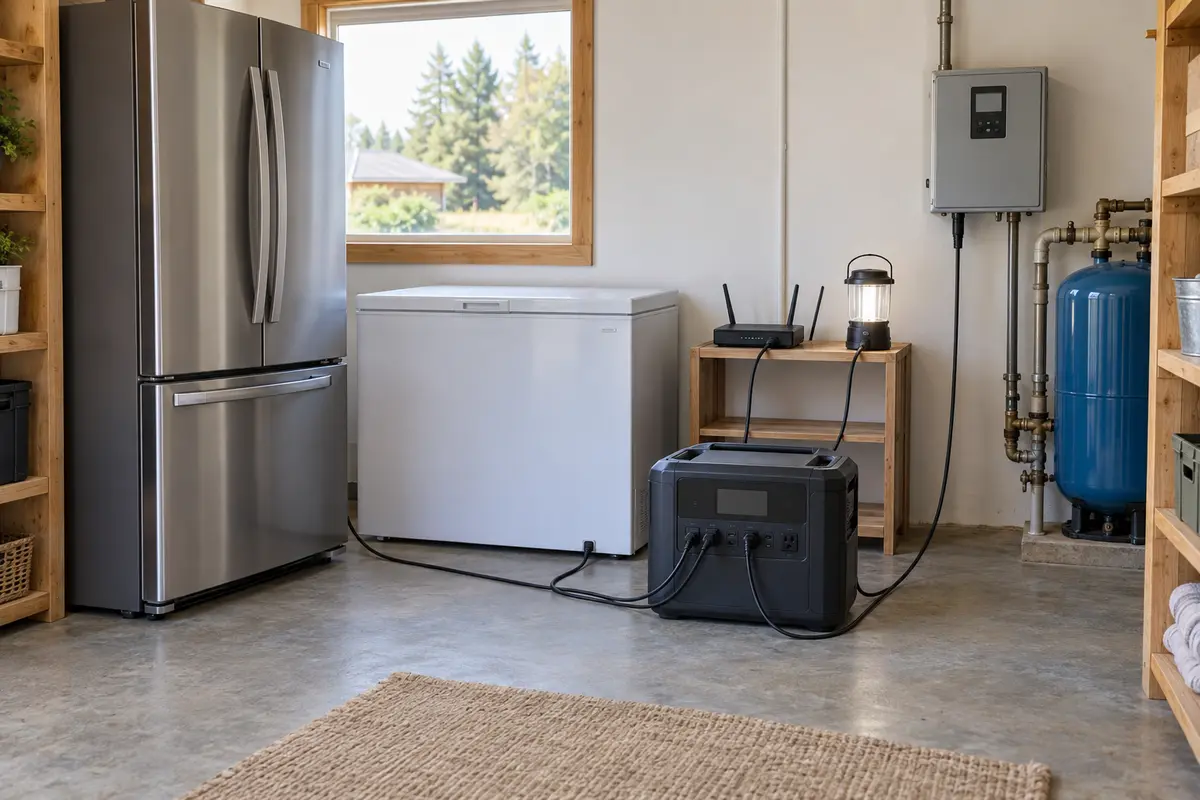
Best overall: Jackery Explorer 5000 Plus
The Explorer 5000 Plus starts with 5,040Wh and delivers 7,200W rated output with a 14,400W surge rating, according to Jackery. It supports both 120V and 240V loads and uses lithium iron phosphate battery chemistry. Jackery states that the system can expand from 5kWh to 60kWh, depending on the equipment and battery configuration.
That combination makes it easier to cover refrigerators, freezers, lights, communications, a well pump, and selected high-demand appliances without immediately buying two inverter units. The large base battery also gives it more useful runtime than the smaller BLUETTI and PECRON systems before expansion batteries are added.
The drawbacks are weight, price, and ecosystem cost. A home connection kit, compatible panels, and expansion batteries can move the total far beyond the advertised price of the power station.
Check the current Jackery Explorer 5000 Plus package.
Best charging flexibility: Anker SOLIX F3800 Plus
The F3800 Plus has 3,840Wh of base capacity, 6,000W AC output, and 120V/240V capability. Anker lists up to 3,200W of solar input for the Plus model and compatibility with 240V generator charging through supported equipment. Those charging options matter during a long outage because battery capacity alone cannot solve several cloudy days.
Choose the Anker when you want to combine solar recovery with a generator or plan to add a transfer system. The smaller base battery means you should calculate overnight loads carefully. A 6,000W inverter can run heavy loads quickly, but a 3,840Wh battery can also empty quickly when several of those loads run together.
See the current Anker SOLIX F3800 Plus bundle.
Best modular ecosystem: EcoFlow DELTA Pro 3
EcoFlow DELTA Pro 3 starts at 4,096Wh with 4,000W continuous output. It uses LFP cells, works with EcoFlow extra batteries and Smart Home Panel equipment, and accepts up to 2,600W of solar input according to EcoFlow’s current installation guidance.
There is an important operating detail: one DELTA Pro 3 can provide 120V or 240V output, but EcoFlow says it does not provide both modes at the same time. Buyers who need simultaneous mixed-voltage service should confirm the required hub, second unit, or panel configuration before ordering.
Compare the current EcoFlow DELTA Pro 3 packages.
Best compact 240V option: BLUETTI Apex 300
BLUETTI Apex 300 supplies 2,764.8Wh and 3,840W AC output, with 7,680W peak output listed by BLUETTI. It supports 120V/240V and can grow into a much larger battery system with compatible expansion batteries and hubs.
The lower base capacity makes it better for targeted backup than an all-day collection of heavy loads. Its expansion range is the attraction. You can begin with the power station and add batteries when measured energy use shows what you need.
Check BLUETTI Apex 300 pricing and bundles.
Best budget essential-load option: PECRON E3600 LFP
PECRON lists 3,072Wh of capacity and 3,600W AC output for the E3600 LFP. It can be a lower-cost route to refrigerator, freezer, lighting, internet, and small-appliance backup. PECRON also lists a maximum 2,400W solar input for this model.
Treat it as an essential-load system unless the exact configuration supports every voltage and connection your home needs. Do not assume that a 3,600W product name means it can operate a 240V well pump or connect to a household panel. Verify the outlets, voltage mode, transfer equipment, and startup-surge requirements first.
See the current PECRON E3600 LFP offer.
Solar input determines whether the system can recover
A large battery is useful for the first night. Solar input determines how well it recovers after that.
Use this rough planning formula:
Daily solar harvest = array watts × peak-sun hours × 0.75
A 2,000W array receiving four peak-sun hours would produce about 6,000Wh under this conservative planning factor. Shade, clouds, panel temperature, wire loss, panel angle, and controller limits can reduce output. Winter production in Massachusetts can be far lower than a clear summer-day estimate.
Check each unit’s solar voltage range, current limit, connector requirements, and total input limit before combining panels. Exceeding the allowed input voltage can damage equipment.
How to connect a solar generator to a house safely
Never backfeed a home through a wall outlet. The Electrical Safety Foundation International warns against connecting generation equipment directly to household wiring without an appropriate transfer switch. Backfeeding can injure utility workers, damage equipment, and create a fire or shock hazard.
Use manufacturer-approved home connection equipment and a transfer switch, interlock, or smart panel installed for the intended system. Local code, permits, neutral bonding, grounding, service configuration, and generator inlet requirements vary. A licensed electrician should confirm the design before the system energizes household circuits.
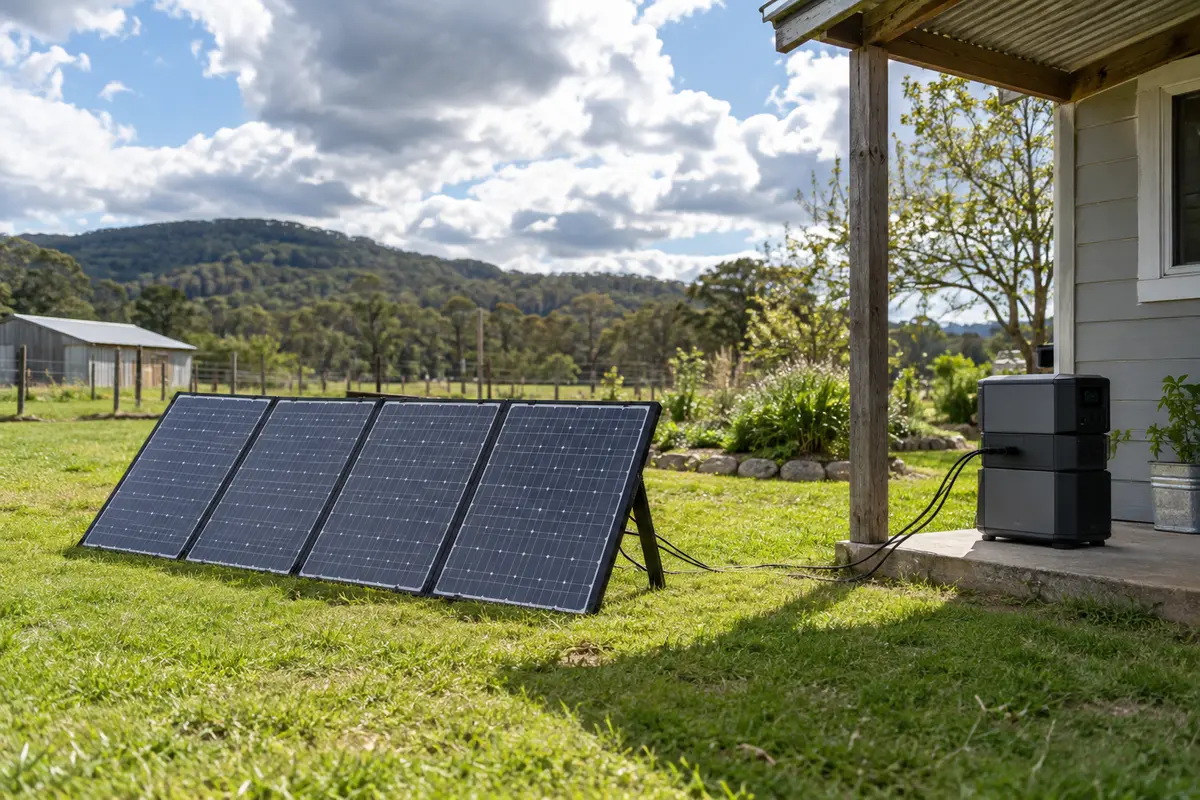
A portable power station used through its own outlets is simpler. Plug approved loads directly into the unit and follow the manufacturer limits. Do not improvise adapters to force incompatible outlets or voltage modes together.
Choose the system by the outage you need to survive
- Refrigeration and communications: Start near 2 to 4kWh, then measure actual use.
- Refrigeration, well pump, lights, and small appliances: Look for 240V support where required, enough surge output, and roughly 4 to 8kWh of usable storage.
- Whole-home load management: Prioritize a transfer system, expandable batteries, and enough output for the loads you will permit at the same time.
- Multi-day off-grid use: Size charging first. Add solar, generator integration, or both so the batteries can recover in poor weather.
For most homesteads, backing up every circuit is expensive and unnecessary. A critical-load plan usually gives better runtime and lowers the total system cost. Refrigeration, water, communications, medical devices, livestock systems, and safe lighting belong ahead of electric resistance heat, an electric range, or central air conditioning.
Start with the practical off-grid essentials guide if you are planning more than emergency backup. If you are building a larger battery bank, review the site’s off-grid solar battery guide before committing to one product ecosystem.
Our 2026 verdict
Choose Jackery Explorer 5000 Plus for the strongest all-around base system. Choose Anker F3800 Plus when charging flexibility is the priority. EcoFlow DELTA Pro 3 fits buyers who want EcoFlow’s panel and battery ecosystem. BLUETTI Apex 300 is a practical smaller starting point with room to expand. PECRON E3600 LFP is the budget pick for planned essential loads, not an automatic whole-home solution.
Before buying, write down three numbers: the largest starting surge, total daily watt-hours, and the solar energy you can realistically collect on a poor-weather day. Those numbers will tell you more than a product’s headline wattage.