A microgreens business plan should answer three questions before you buy more equipment: who will buy your harvest, what each sale costs to fulfill, and how you will grow and handle a safe product. Start with a one-page plan for a small pilot. Expand it into a lender-ready plan only if you need financing. The template below gives you the sections and numbers to fill in without pretending that a forecast is a customer order.
Use this page as a working template: copy the prompts into your own document and replace every assumption with a quote, test result, or buyer conversation. The numerical example is hypothetical, not a real farm’s performance or a promised return.
Microgreens business plan template
| Section | Write down | Evidence to collect |
|---|---|---|
| Offer and customer | Varieties, package size, price, buyer type, delivery area | Buyer interviews and competing offers |
| Sales path | How buyers discover, sample, order, pay, and reorder | Trial orders and follow-up notes |
| Production | Trays, cycle time, expected sellable yield, harvest days | Your own batch logs |
| Food safety | Water, seed, sanitation, traceability, cold handling | Written procedures and local requirements |
| Economics | Startup outlay, price, variable cost, labor, overhead, cash reserve | Supplier quotes and measured time |
| Decision rule | What a pilot must prove before you expand | Paid repeat orders and actual contribution |
The SBA describes lean and traditional business-plan formats. A lean plan fits a small test; a traditional plan adds detail, supporting documents, and projections when a lender or partner needs them.
1. Define a specific offer and buyer
Write one sentence: “We plan to sell [varieties and pack size] to [specific buyer] within [delivery area] through [sales channel], at a proposed price of [amount].” Proposed is the key word until someone orders. Decide whether you are testing chef orders, a farmers market, a produce shop, or direct subscriptions. Each has different packaging, delivery, unsold inventory, and payment timing.
Ask potential buyers what they currently use, how much they order, what package and delivery schedule they need, and what would make them switch. Record the answer and the date. A compliment or a sample request is not a standing order. Our selling microgreens guide covers channel choices; use the restaurant guide if chefs are your first target.
2. Plan production around orders
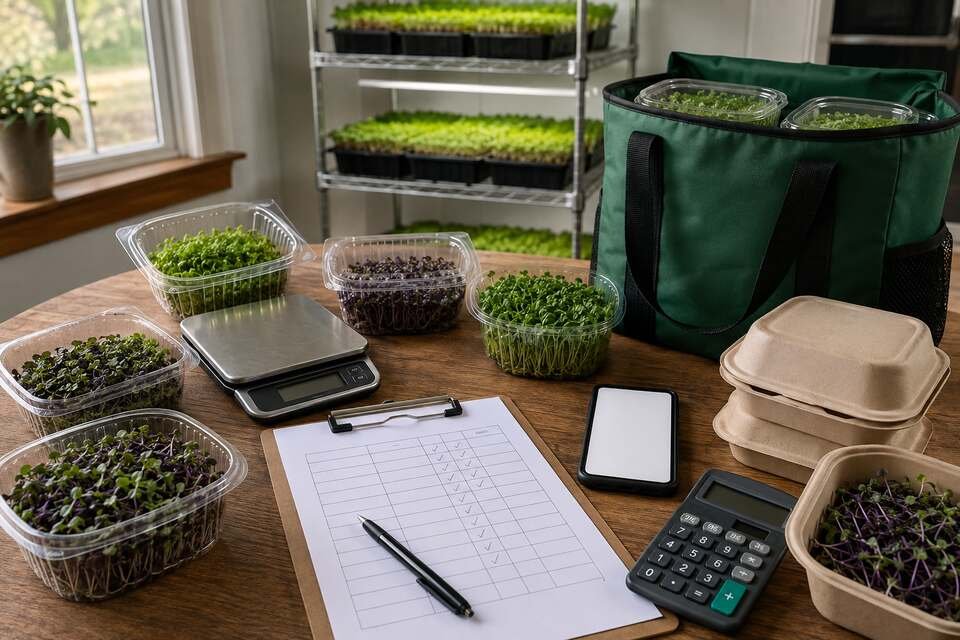
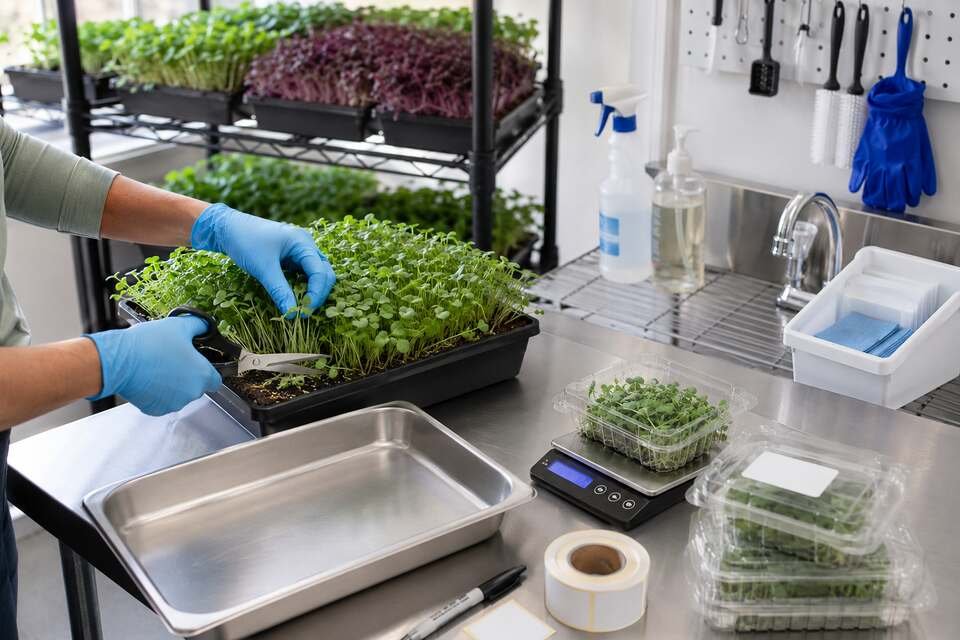
Start with a limited number of trays and varieties. Use our microgreens variety comparison to choose two crops for a paid trial, then keep the ones buyers reorder at a workable margin. For each crop, record seeding date, seed lot, growing conditions, harvest date, saleable weight, packages made, and losses. Your capacity is constrained by growing space, harvest and packing time, and the amount customers will actually buy. Do not assume every tray yields the same amount or every harvested pack sells.
List the equipment you already have and obtain current quotes for what you still need: trays, racks, lights, growing medium, seed, scale, food-contact supplies, packaging, and suitable cold storage. Document cleaning, water, harvest, and transport procedures. Penn State Extension’s microgreens food-safety guidance explains the risks around water and production. Check your state and local agriculture and health authorities for rules that apply to your product, facility, labeling, and sales channels; requirements vary.
3. Build a small cost and break-even model
Separate one-time startup purchases from ongoing expenses. Variable costs rise with units sold: seeds, growing medium, packaging, transaction fees, and delivery attributable to an order. Fixed costs such as insurance, rent, software, and equipment depreciation continue even if sales are slow. Include your labor at a rate you can sustain.
Illustrative pilot only: Suppose a pack sells for $5 and its variable cost, including an allocation for labor and spoilage, is $3. That leaves $2 contribution per sold pack. If monthly fixed costs are $200, the simple break-even point is 100 sold packs ($200 ÷ $2). At 80 paid packs, contribution is $160 and the operation is $40 short of fixed costs. This example excludes taxes, financing, and any startup-cost recovery; your own prices, yield, labor, and losses will differ.
| Monthly pilot assumption | Illustrative amount | Replace with your data |
|---|---|---|
| Price per sold pack | $5 | Actual invoice price |
| Variable cost per sold pack | $3 | Inputs, labor, waste, fees, delivery |
| Contribution per sold pack | $2 | Price minus variable cost |
| Monthly fixed costs | $200 | Overhead and equipment allocation |
| Break-even sold packs | 100 | Fixed costs ÷ contribution |
For a fuller calculation and a sensitivity check, see our microgreens profitability analysis. University of Missouri Extension’s microgreens planning budget supplies an editable enterprise-budget framework, with 2024 Missouri assumptions that you should replace with local quotes and measured yields.
4. Forecast sales and cash separately
Build the first forecast from buyers you have spoken with, expected paid orders, your tested yield, and realistic delivery capacity. Show a conservative case with fewer repeat orders and some unsold harvest. Track cash timing too: seed and packaging may be paid before a wholesale invoice is collected. Keep a reserve for crop failure, equipment replacement, and slow payments. If you seek funding, attach vendor quotes and explain each assumption; do not invent commitments, credentials, or loan terms.
5. Set a 30-day pilot and a decision rule
- Week 1: choose one buyer segment, talk to prospective customers, check local requirements, and obtain input quotes.
- Week 2: run small crop tests and record time, saleable yield, and losses.
- Week 3: offer samples where appropriate, ask for paid trial orders, and calculate full fulfillment costs.
- Week 4: compare paid sales, repeat interest, margin, and cash used against your plan. Expand only when demand and safe production are repeatable.
After the pilot, revise the plan from invoices and batch records. If buyers reject the price, the delivery route is too costly, or the harvest regularly goes unsold, change the offer or channel before adding more racks.
Common questions
Do I need a long business plan to start small?
No. A short plan with real buyer evidence, production records, a safety process, and a cash model is enough to test the idea. A lender may require more detailed projections and documents.
Can I use a market-size estimate as my sales forecast?
No. A broad market figure does not tell you how many local buyers will pay your price. Forecast from your own conversations, trial orders, production capacity, and repeat purchase rate.
When should I buy more equipment?
When repeat orders exceed reliable current capacity and the added equipment’s cost is supported by contribution after labor, waste, delivery, and overhead.
Sources: U.S. Small Business Administration business planning; University of Missouri Extension enterprise budget; Penn State Extension food safety. Figures in the example above are hypothetical and are not income claims.