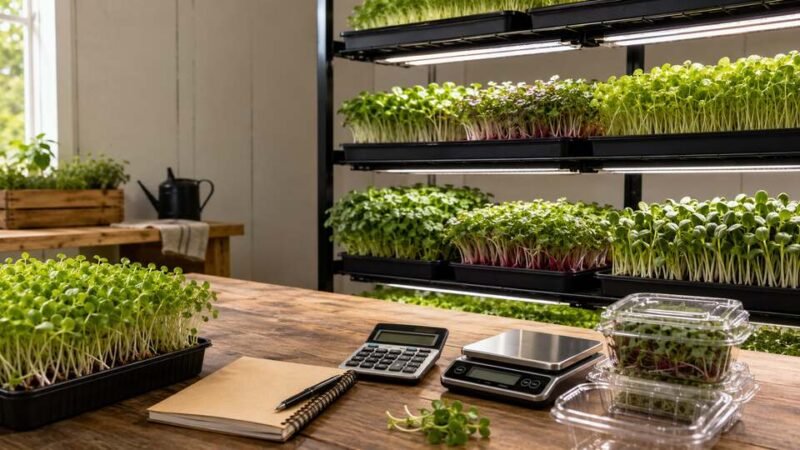
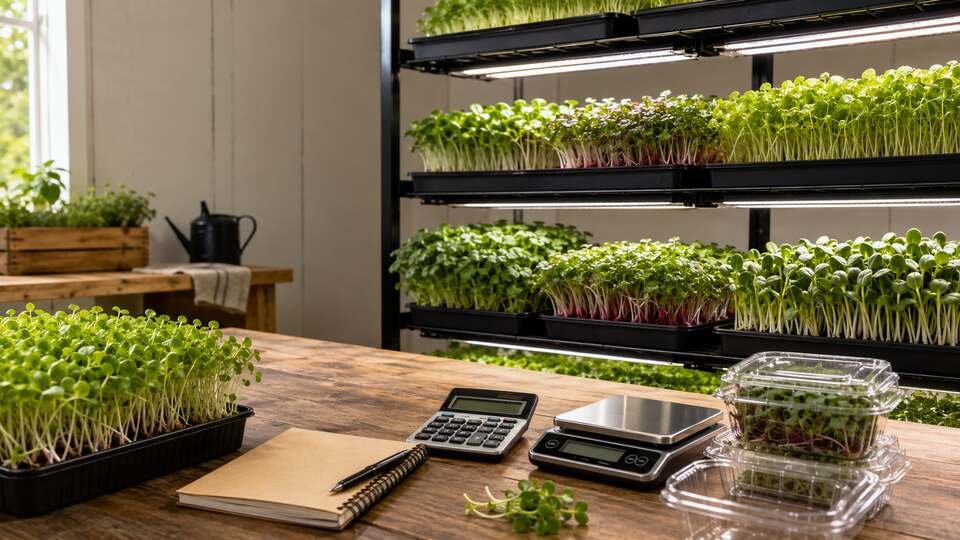
Microgreens can be profitable when paid orders cover your seed, supplies, labor, delivery, waste, and fixed costs. A high selling price per tray does not prove a high net margin. Test demand with a small number of reliable crops, record every cost, and calculate the contribution from actual orders before adding shelves or subscriptions.
This guide shows how to estimate profit per harvest and break-even volume. The numbers below are an example, not a typical result or earnings promise. Your local buyer, crop, space, and sales channel determine the answer.
How do you calculate microgreens profit?
Start with sales revenue = packs sold × price per pack. Subtract the costs that change with production and sales: seed, growing medium, packaging, paid labor or a fair value for your own time, transaction fees, delivery, and losses from unsold or failed trays. The remainder is contribution toward fixed costs. Then subtract the costs of equipment, space, insurance, and other overhead allocated to that period.
Net profit = revenue − variable costs − fixed costs. Net margin is net profit divided by revenue, multiplied by 100. Keep sales tax collected for the government out of your revenue calculation and ask an accountant how to handle equipment, owner pay, and tax in your particular business.
The University of Missouri Extension microgreens planning budget provides a useful cost framework and a customizable estimate column. Its published figures assume a Missouri greenhouse, shelf system, and artificial lighting with 2024 price forecasts. Replace those assumptions with your own; they are not a universal margin benchmark.
A small-batch profitability example
Suppose a harvest produces 20 paid packs at $5 each. The table includes a value for the grower’s time. It assumes the batch is already sold and that $15 of monthly fixed expense is allocated to it.
| Illustrative batch | Amount |
|---|---|
| 20 paid packs × $5 | $100 revenue |
| Seed and growing medium | $18 |
| Packaging and labels | $12 |
| Labor, 2 hours × $15 | $30 |
| Delivery and payment fees | $10 |
| Waste allowance | $10 |
| Total variable costs | $80 |
| Contribution before fixed costs | $20 |
| Allocated fixed costs | $15 |
| Illustrative net profit | $5, or 5% of revenue |
If five packs do not sell, you cannot keep the same $100 revenue. The crop, packing, and time costs may already be incurred. Recalculate with 15 paid packs and the actual costs incurred. That is why paid repeat demand matters more than a theoretical yield or a quoted tray price.
Which expenses are easy to miss?
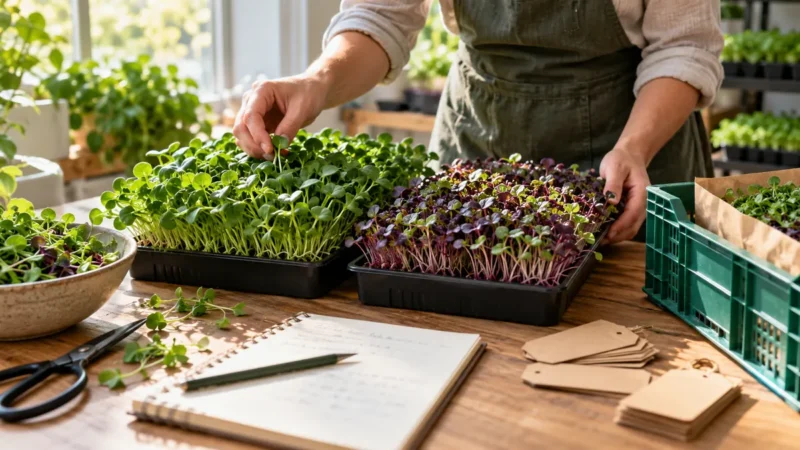
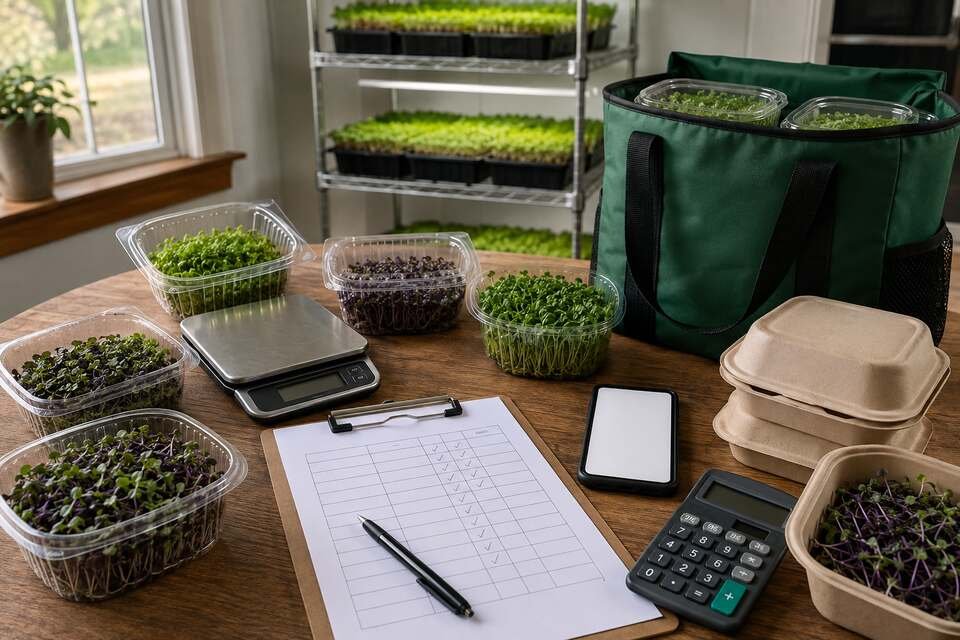
Growers often count seeds and medium but overlook their time. Keep a log from sowing through washing equipment, harvesting, weighing, packing, messaging customers, and delivery. A small order can consume more time than its crop value warrants if it requires a separate trip.
- Production: seed, medium, trays, water, lights, electricity, cleaning supplies, and failed batches.
- Sales: packs, labels, samples, market fees, payment processing, customer acquisition, refunds, and unsold product.
- Fulfillment: harvest and packing labor, cold storage where appropriate, travel, and customer service.
- Overhead: shelves, equipment replacement, insurance, rent or a share of household space, permits, and bookkeeping.
Equipment purchased once still has an economic cost. Spread its useful life across the batches it supports rather than treating the first harvest as if the lights and racks were free. Do not label a crop organic unless your practices and claims meet applicable requirements.
How many packs must you sell to break even?
For a single consistent pack, break-even packs = fixed costs ÷ contribution per pack, rounded up to a whole pack. Contribution per pack is selling price minus the variable cost of filling and selling one more pack. If fixed costs are $150 per month and a $5 pack contributes $2 after variable costs, you need 75 paid packs that month to cover those fixed costs. You have not earned a net profit at that point.
Be careful when using this formula for mixed varieties or channels. Restaurant delivery, farmers-market fees, and direct pickup can produce different contributions per pack. Calculate each channel separately, then compare which orders reliably cover your time and overhead.
Which sales channel supports the best margin?
The highest posted price is not necessarily the best result. A restaurant may buy larger repeat quantities but require samples, consistent specifications, and delivery. Direct local preorders may pay more per pack but take time to manage individually. A market can attract buyers, yet stall fees and unsold greens affect the result. Record the full contribution by channel before committing to more production.
Our microgreens sales guide helps you choose a first channel. Use the restaurant pitch guide for chef accounts, or the local preorder guide for pickup and delivery. Start with a few paid orders and learn which offer customers will buy again.
What should you measure in your first month?
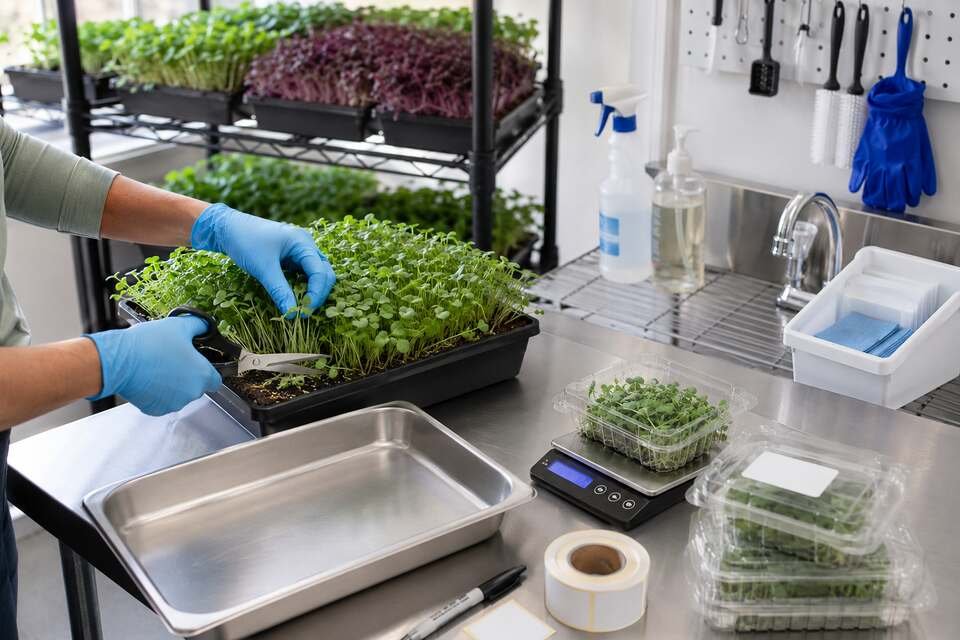
Choose one or two varieties you can grow consistently. For each sowing, record seed weight, usable harvest weight, packs sold, selling price, hours worked, supplies, and any discarded product. Compare your projected costs with what you actually spend. Ask buyers about pack size and pickup day, then repeat the offer that produces paid orders and a workable margin.
Keep food safety in the plan. The Penn State Extension microgreens food-safety guide discusses production risks, and the FDA Produce Safety Rule explains federal requirements. Check state and local rules for your facility and sales channel. A cheap process is no bargain if product handling is unsafe.
Build your own setup and cash-flow assumptions with our microgreens business-plan guide. If you want structured paid training after validating buyers, our Freedom Farmers review explains its current public curriculum, listed price, and enrollment questions. We may earn a commission if you purchase through links on that review.